Dollar General: Real Momentum, Wrong Price
Dollar General is doing better. I’m selling it anyway.
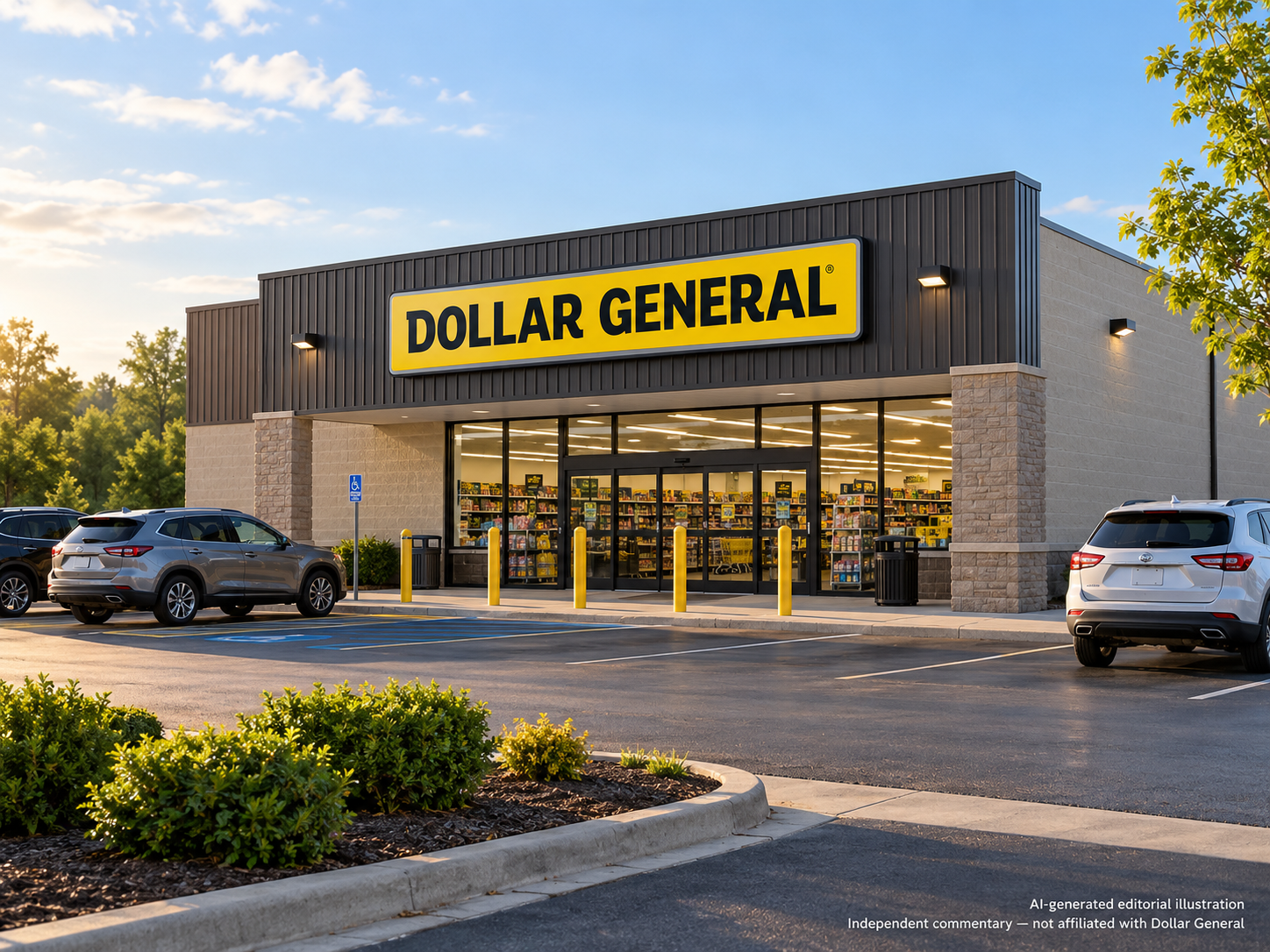
AI-generated illustration. Independent commentary, not affiliated with Dollar General.
Dollar General is doing better. The turnaround has been working, and the stock has recovered from the low $70s in 2024. I’m selling it anyway. Those aren’t contradictory statements. A company can improve, management can execute, earnings can rise—and the stock can still stop earning its place in the portfolio. That’s where I am with Dollar General.
I explore several plausible scenarios over the next five years and ask one core question: at today’s price, am I being paid enough for the things I might be wrong about? For new money, I want the expected IRR to be roughly 15% a year. For a stock I already own, I use about 10% as the point where I start asking whether the capital still belongs there. Those aren’t predictions. These returns are my margin of safety against my flawed assumptions. I don’t need the crowd to make me comfortable. I need enough margin of safety to survive when I’m wrong.
After the August earnings report, I ran the numbers on September 3 when DG was $131.55. My probability-weighted five-year value came out to $152.69. That’s the expected year-five share value; dividends are counted separately when I calculate the return. At $131.55, that meant an expected return of only about 4.9% a year. The stock has since fallen to $118.94 as of October 2. Better, but the bigger problem didn’t go away. On the same assumptions, my 15% buy price is $84.47. Dollar General isn’t broken. I just don’t think the growth is good enough at today’s valuation.
The turnaround is real
There is plenty to like in the recent numbers. Dollar General has posted positive comparable sales across all four merchandise categories for six straight quarters, and customer traffic has grown for five. Management has raised fiscal 2026 guidance twice. That’s real progress, not a turnaround built on promises. The customers are showing up, sales are moving in the right direction, and CEO Todd Vasos deserves credit for it.
There is an asterisk, though. Dollar General received a one-time tariff refund that added roughly $0.25 per share to second-quarter earnings, and management put that money back into lower prices and promotions. That decision doesn’t bother me. My question is: what did they buy with it? If those lower prices create lasting traffic, improve customer perception and take share, great. If they simply had to hand the money back to customers to keep traffic from slipping, the headline improvement looks better than the underlying economics. We don’t know yet. And Vasos, who led it, is leaving.
Now somebody else gets the keys
JJ Fleeman Jr. takes over as CEO on January 1, 2027. He’s an outside hire from grocery and doesn’t have a small-box discount-retail track record. The recovery we can see today belongs mostly to Todd Vasos. The next five years don’t. Fleeman may be terrific. I’m just not going to pay him in advance for a job he hasn’t done yet.
For the bullish case to work, the current momentum has to survive two things: the tariff benefit going away and a CEO transition. Both may go fine, but neither has happened yet. At the right price, I’ll take that uncertainty. At $119, I don’t have to.
Uncertainty isn’t the problem. Unpaid uncertainty is!
Cash flow is another warning sign
There is one other loose thread. In the first half of fiscal 2026, operating cash flow fell even as net income rose, with about $249 million of cash tied up in inventory. Maybe it’s timing. I don’t know. It may be nothing more than that. But when I’m already being asked to pay for a lot of the turnaround, I don’t want to wave away weaker cash conversion just because the income statement looks better. Earnings can improve before the cash shows up. That may be harmless here, but I want to see the cash catch up.
Dollar General also has a lease-heavy footprint. Roughly 21,000 stores give it scale and convenience, but they also give it a lot of fixed cost. If store economics get worse, management can’t shrink the footprint overnight. My underwriting uses about $11.2 billion of operating lease obligations with a nine-year average remaining term. You can’t put 21,000 stores on eBay. None of this says disaster. It says the price has to leave room for mistakes.
Four ways the next five years could go
I don’t pretend I know exactly what Dollar General will earn five years from now. I use several plausible outcomes instead. A single forecast can look very impressive right up until reality shows up. And real life is always messy.
| Scenario | Probability | Year-5 free cash flow/share | Multiple | Value |
|---|---|---|---|---|
| Compounding reacceleration | 15% | $14.70 | 16x | $235.20 |
| Steady execution | 50% | $12.21 | 14x | $170.94 |
| Margin compression | 25% | $9.58 | 11x | $105.38 |
| Structural impairment | 10% | $7.00 | 8x | $56.00 |
Put the scenarios together and I get a weighted five-year value of $152.69. But the number by itself isn’t the point. What matters is what has to go right to get there. My base case gets half the probability because it asks for the fewest miracles: current guidance is met, the tariff refund disappears without taking a chunk out of the economics, competition stays manageable, and the CEO change is annoying rather than damaging. That’s a perfectly respectable business. At today’s price, it still isn’t enough return.
The case I worry about more is margin compression. Competitors keep spending on price, DG has to keep promoting just to defend traffic, the tariff benefit disappears, margins stay under pressure and capital allocation gets more conservative. I give that a 25% probability because I’m not inventing the ingredients. Management is already talking about a difficult promotional environment and modest SG&A deleverage. In that world, I get about $105 a share.
So at roughly $119, I’m not looking at some giant margin of safety while worrying about a freak accident. I’m already above the value of a bad outcome that I think is pretty plausible.
The stock got cheaper. So why am I selling?
That’s the fair question. At $131.55, my expected return was only about 4.9%. At $118.94, a rough update using the same $152.69 five-year value and dividend assumption—not a fresh full underwriting—gets me to roughly 7%. The stock is more attractive than it was a month ago. But cheaper doesn’t automatically mean attractive.
The bigger issue is what Dollar General can realistically compound from here. Management’s long-term framework calls for about 2% annual new-unit growth, roughly 3.5% to 4% annual net sales growth, and about 2% to 3% same-store sales growth. For 2026, management plans roughly 450 new U.S. stores and about 10 in Mexico. Even in a year running above its own long-term framework, Dollar General is guiding to about 4.0% to 4.3% net sales growth and 2.5% to 2.9% same-store sales growth.
That doesn’t contradict the turnaround. The recent operating improvement is real. But a turnaround and a great compounder are not the same thing. More stores help, but if the underlying sales and per-share growth stay modest, the footprint by itself doesn’t create enough value to justify paying a full price.
My September base case assumes roughly 6% annual growth in free cash flow per share over the next five years. That’s not bad, but it’s also not enough for me at this price. At roughly $119, I think Dollar General is fully valued for the growth I see. The roughly 7% expected return is below the roughly 10% return I want from a stock I already own. That’s confirmation, not the whole reason. What matters more is that the growth I now expect from the business doesn’t justify keeping the capital there at this price.
The stock got cheaper, but the economics still don’t clear my bar. That’s why I’m selling.
I can own a slow grower. I can own a fully valued company. I just don’t particularly want to own both at the same time.
What would bring me back?
For context, $84.47 is my 15% new-money price, $104.51 is the 10% value I use for an existing holding, and $67.58 is my strong-buy level—the point where I would aggressively go back through the numbers. Those are not forecasts for where DG will trade. They are the prices where the return starts paying me for being wrong.
Price can change the answer. So can the business. The biggest thing I want to see is whether Dollar General can hold onto its gross-margin improvement after the tariff refund disappears. If traffic and share keep improving without giving away the economics, then the promotions probably bought something durable instead of just buying sales for a quarter.
I also want to see Fleeman run the company. Not a speech. Not a strategy deck. Execution. Keep the remodel, digital and shrink-reduction work moving. Avoid a bunch of senior-level disruption. Keep capital allocation sane. More important, show me that all of that translates into faster growth in free cash flow per share. If that happens, I can raise the value I am willing to put on DG. If the price gets cheap enough first, I can always look again.
Why I’m selling
I don’t think Dollar General is broken, and I don’t think the turnaround has failed. I’m selling because the growth I see doesn’t justify keeping capital tied up at the return I’m being offered. If the price gets cheap enough, I can come back. If the business proves it can compound faster than I expect, I can come back then too. I don’t need to own it while I wait.
This is a snapshot, not a permanent verdict. The next real checkpoint is fiscal Q3, expected in early December 2026, or the CEO change on January 1, 2027—whichever gives me useful new evidence first.
That’s Ruthless. Predicting the future, not prewriting history.
— Ruthless
This is not investment advice. It reflects my own analysis, not a recommendation to buy or sell any security. Disclosure: I own shares of Dollar General (DG).
Sources: Dollar General SEC Form 10-Q (period ended August 1, 2026) and Form 10-K (fiscal 2025); Q2 FY2026 earnings release (August 27, 2026); company guidance updates and long-term financial framework; CEO transition announcement; stockanalysis.com (price and market data retrieved October 2, 2026).
Analysis and decisions are mine; I use AI tools to help edit.
Do the math on your own numbers.
Free calculators →